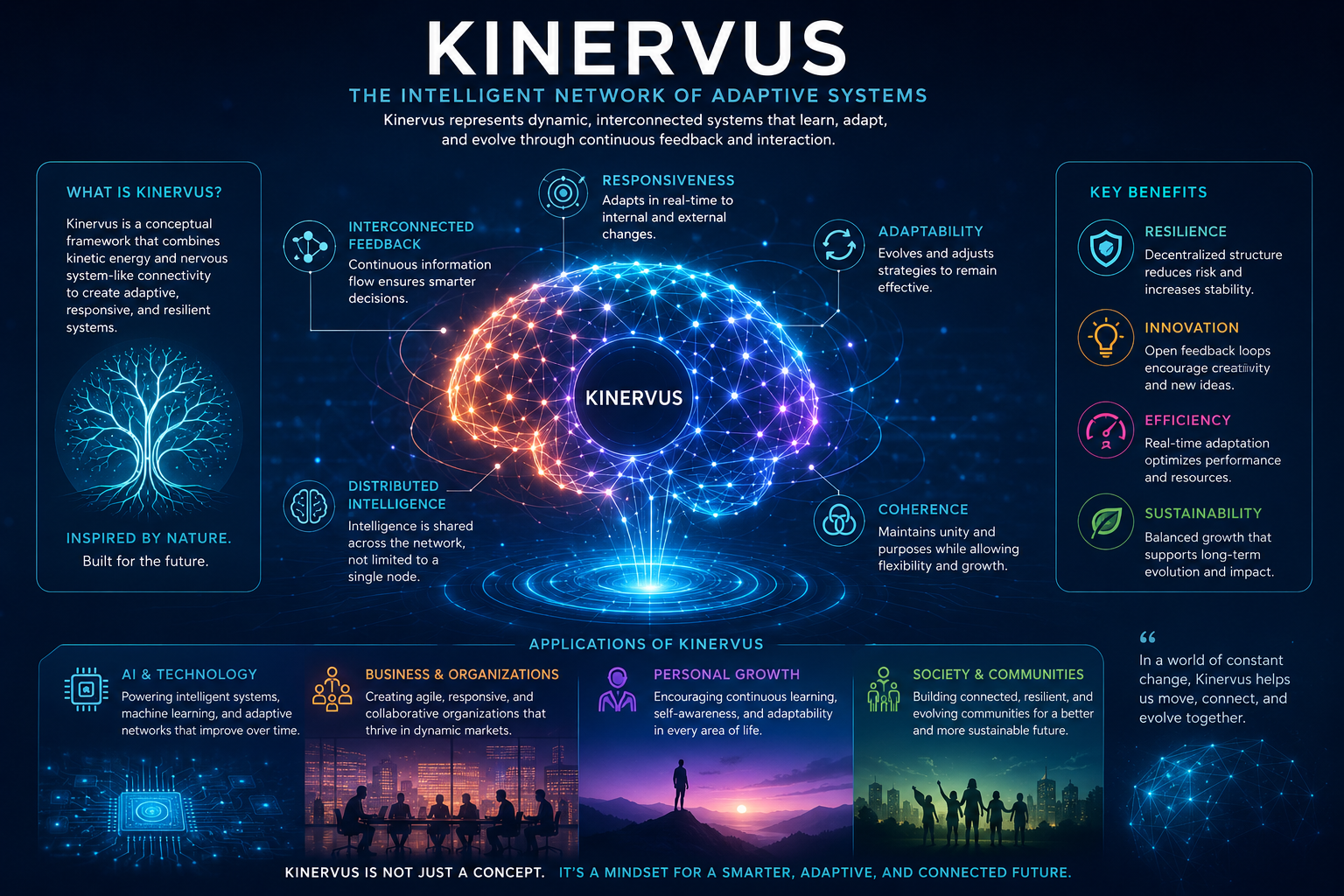
Introduction to Kinervus
Kinervus is an emerging conceptual keyword that represents a modern way of thinking about adaptive systems, intelligent connectivity, and dynamic growth structures. While the term itself may not yet belong to traditional academic or industrial vocabularies, it is increasingly used as a symbolic framework to describe systems that behave like living networks. These systems respond, evolve, and reorganize themselves based on internal signals and external conditions, much like a nervous system in a living organism.
In today’s rapidly changing digital and organizational landscape, the need for flexible, responsive, and intelligent systems has never been greater. Traditional models often rely on fixed structures, linear workflows, and rigid hierarchies. However, modern challenges require something more fluid and adaptive. This is where the conceptual idea of becomes relevant. It represents a fusion of kinetic energy principles and nervous system-like adaptability, forming a metaphor for interconnected intelligence.
At its core, can be understood as a framework that emphasizes motion, responsiveness, and interconnected decision-making. It is not limited to one field. Instead, it can be applied to technology, business strategy, personal development, artificial intelligence, and even social systems. The keyword “kinervus” symbolizes an evolving mindset where systems are not static but continuously learning and adapting.
This article explores Kinervus in depth, breaking down its meaning, conceptual origins, core principles, and real-world applications. It also examines its potential future impact on industries and personal growth systems. By the end, readers will have a complete understanding of how functions as both a conceptual model and a practical lens for interpreting modern complexity.
Understanding the Core Meaning of Kinervus
To understand Kinervus, it is important to break it down conceptually rather than linguistically. The word itself suggests a combination of “kinetic,” meaning movement or energy in motion, and a structure reminiscent of a nervous system, which is responsible for communication and response in living organisms. When these two ideas are merged, represents a system that is both active and responsive.
In a Kinervus-inspired model, every part of a system is connected and capable of influencing other parts. This interconnectedness creates a flow of information that allows the system to adapt quickly. Unlike traditional static models, Kinervus-based systems are constantly shifting and evolving based on feedback loops.
This concept is particularly useful in understanding modern digital environments. For example, online platforms, artificial intelligence systems, and cloud-based infrastructures all rely on continuous data exchange. These systems must respond instantly to user behavior, environmental changes, and internal performance metrics. provides a way to describe this dynamic behavior in a unified conceptual framework.
Another important aspect of Kinervus is its emphasis on balance between structure and flexibility. While the system is highly adaptive, it still maintains a coherent structure that allows it to function efficiently. This balance ensures that adaptability does not lead to chaos, and structure does not lead to rigidity.
In essence, Kinervus represents a middle ground between order and fluidity. It is a model that acknowledges the importance of both stability and change, making it highly relevant in modern complex systems.
Conceptual Origins and Philosophical Background of Kinervus
The conceptual foundation of Kinervus can be traced to several intellectual traditions, even though the term itself is modern and symbolic. One of the strongest influences is systems thinking, which studies how parts of a system interact to produce collective behavior. Systems thinking emphasizes that the whole is greater than the sum of its parts, a principle that is deeply aligned with Kinervus.
Another influence comes from biological inspiration, particularly the study of the human nervous system. The nervous system is one of the most efficient communication networks in nature. It processes signals, makes decisions, and triggers responses in real time. adopts this biological metaphor to describe how artificial and organizational systems can achieve similar efficiency.
Cybernetics also plays a role in shaping the conceptual background of Kinervus. Cybernetics focuses on feedback loops, control systems, and communication within machines and living beings. extends this idea by emphasizing not just control, but continuous evolution and adaptation.
Philosophically, Kinervus aligns with ideas of emergence and complexity. Emergent systems are those in which simple interactions between components lead to complex behaviors. suggests that intelligence and efficiency can emerge naturally from well-designed networks of interaction, rather than being imposed from a central authority.
This philosophical background makes more than just a technical idea. It becomes a way of understanding reality itself, especially in environments where change is constant and unpredictability is the norm.
Core Principles of the Kinervus Framework
The Kinervus framework is built upon several core principles that define how such systems behave and operate. These principles are not rigid rules but rather guiding ideas that help explain the behavior of adaptive, interconnected systems.
One of the central principles is responsiveness. In a Kinervus system, every component must be capable of reacting to changes in its environment. This responsiveness ensures that the system remains relevant and functional even under shifting conditions.
Another principle is interconnected feedback. Information flows continuously between different parts of the system, allowing for real-time adjustments. This feedback loop ensures that decisions are informed by the most current data available, reducing delays and inefficiencies.
Adaptability is also a key principle. A -based system does not remain fixed in one configuration. Instead, it evolves over time as new information becomes available. This adaptability allows it to remain resilient in the face of uncertainty.
A further principle is distributed intelligence. Rather than relying on a single central decision-maker, systems distribute intelligence across multiple nodes. Each node contributes to decision-making, creating a more balanced and efficient structure.
Finally, coherence is essential. Even though the system is distributed and constantly changing, it still maintains a sense of unity and purpose. Without coherence, adaptability could lead to fragmentation. ensures that all parts of the system remain aligned toward a common objective.
These principles together form a conceptual foundation that can be applied across many domains, from technology to human organizations.
Kinervus in Technology and Artificial Intelligence
In the field of technology, offers a powerful way to understand modern systems such as artificial intelligence, cloud computing, and decentralized networks. These technologies rely heavily on continuous data flow, feedback loops, and adaptive algorithms, all of which align closely with the Kinervus concept.
Artificial intelligence systems, for example, learn from data inputs and adjust their outputs accordingly. This learning process is inherently -like because it depends on continuous feedback and adaptation. Machine learning models improve over time by analyzing patterns and adjusting their internal parameters, reflecting the dynamic nature of Kinervus.
Cloud computing systems also demonstrate Kinervus principles. These systems distribute workloads across multiple servers, adjusting resources based on demand. This dynamic allocation ensures efficiency and reliability, especially under varying conditions.
Decentralized technologies, such as distributed networks, further illustrate in action. In these systems, no single node has complete control. Instead, each node contributes to the overall function of the network. This distributed structure enhances resilience and reduces the risk of failure.
Kinervus can also be applied to the development of intelligent ecosystems where different technologies interact seamlessly. In such ecosystems, devices, applications, and data sources communicate continuously, creating a unified and responsive environment.
As technology continues to evolve, the framework may become increasingly relevant as a way to design and understand complex adaptive systems.
Kinervus in Business Strategy and Organizational Design
Modern businesses operate in environments characterized by uncertainty, competition, and rapid change. Traditional hierarchical models often struggle to keep up with these demands. Kinervus offers an alternative approach that emphasizes flexibility, responsiveness, and distributed decision-making.
In a Kinervus-inspired business model, organizations function more like living systems than rigid structures. Information flows freely across departments, allowing for faster decision-making and improved collaboration. This reduces bottlenecks and enhances overall efficiency.
Leadership in such systems is not purely top-down. Instead, leadership becomes more distributed, with teams and individuals empowered to make decisions based on real-time information. This creates a more agile and responsive organization.
Another important aspect is adaptability to market conditions. Businesses that follow principles are better equipped to respond to changes in consumer behavior, technological advancements, and economic fluctuations. They can pivot strategies quickly without losing structural integrity.
Innovation also plays a central role in -based organizations. Because information flows freely and feedback loops are active, new ideas can emerge organically from within the system. This encourages continuous improvement and creativity.
Overall, Kinervus in business strategy represents a shift away from rigid control systems toward dynamic, interconnected ecosystems that prioritize responsiveness and resilience.
Kinervus in Personal Development and Human Growth
Beyond technology and business, Kinervus can also be applied to personal development. In this context, it represents the idea that human growth is not linear but dynamic and interconnected.
Personal development through a lens involves continuous learning, adaptation, and self-reflection. Individuals are seen as systems that respond to internal thoughts, external environments, and feedback from experiences.
This perspective encourages flexibility in thinking and behavior. Instead of following a fixed path, individuals adapt their goals and strategies based on changing circumstances. This leads to more realistic and sustainable growth.
Emotional intelligence also plays a significant role in Kinervus-based personal development. Understanding one’s emotions and responses allows for better decision-making and improved relationships with others. This emotional awareness acts as a feedback mechanism that supports personal evolution.
Another important aspect is the integration of different areas of life. Kinervus suggests that personal, professional, and social dimensions are interconnected rather than separate. Changes in one area can influence others, creating a holistic system of growth.
By adopting a Kinervus mindset, individuals can become more resilient, adaptable, and aware of the complex interactions that shape their lives.
Benefits and Challenges of the Kinervus Concept
The Kinervus framework offers several significant benefits. One of the most important is its ability to handle complexity. In environments where change is constant, Kinervus-based systems can adapt quickly and efficiently.
Another benefit is resilience. Because these systems are distributed and interconnected, they are less vulnerable to failure. If one part of the system is disrupted, others can compensate.
Kinervus also enhances innovation by encouraging continuous feedback and interaction. This creates an environment where new ideas can emerge naturally.
However, there are also challenges associated with implementing Kinervus-like systems. One challenge is maintaining coherence. With so many interconnected parts, ensuring alignment can be difficult.
Another challenge is managing complexity itself. While Kinervus thrives in complex environments, it also requires careful design and monitoring to prevent overload or inefficiency.
Despite these challenges, the potential benefits make Kinervus an attractive conceptual model for modern systems.
The Future of Kinervus in a Changing World
As the world becomes increasingly interconnected and data-driven, the relevance of Kinervus is likely to grow. Future technologies will rely even more heavily on adaptive systems that can learn and respond in real time.
In artificial intelligence, Kinervus-like architectures may lead to more advanced and autonomous systems capable of complex decision-making. In business, organizations may become more decentralized and flexible, mirroring biological systems more closely.
Even in society as a whole, Kinervus principles may influence how communities, economies, and communication networks evolve. The shift toward interconnectedness suggests that future systems will increasingly resemble dynamic networks rather than static structures.
This evolution highlights the importance of understanding Kinervus not just as a concept, but as a guiding framework for future development.
Conclusion
Kinervus represents a powerful and modern way of understanding systems that are dynamic, interconnected, and adaptive. While it may be a conceptual keyword, its implications are far-reaching and deeply relevant to today’s world. From artificial intelligence and business strategy to personal development and social systems, Kinervus provides a lens through which complexity can be understood and managed.
At its core, Kinervus is about movement, connection, and responsiveness. It challenges traditional static models and replaces them with living systems that evolve continuously. This shift in perspective is essential in a world where change is constant and unpredictability is the norm.
By embracing the principles of Kinervus, individuals and organizations can develop greater resilience, adaptability, and intelligence. As systems continue to evolve, the Kinervus framework will likely become even more significant, shaping how we design, interact with, and understand the world around us.