In the rapidly evolving landscape of digital language and online culture, new terms and expressions appear with surprising frequency. One such emerging keyword that has started to attract curiosity is wifekivers. At first glance, the term may seem unusual or even unfamiliar, yet it represents a broader trend in how online communities create, adapt, and assign meaning to new linguistic expressions.
The concept of wifekivers can be understood as part of a growing pattern in which internet users blend personal identity, social roles, and cultural expression into unique keywords that circulate across digital platforms. While the term itself may not have a fixed dictionary definition, its relevance lies in how it is interpreted, used, and shaped by communities that adopt it.
This article explores wifekivers in depth, breaking down its possible meanings, cultural implications, psychological associations, and its place within modern digital communication. By the end of this comprehensive guide, readers will gain a clearer understanding of how such terms evolve and why they matter in today’s interconnected world.
What is Wifekivers?
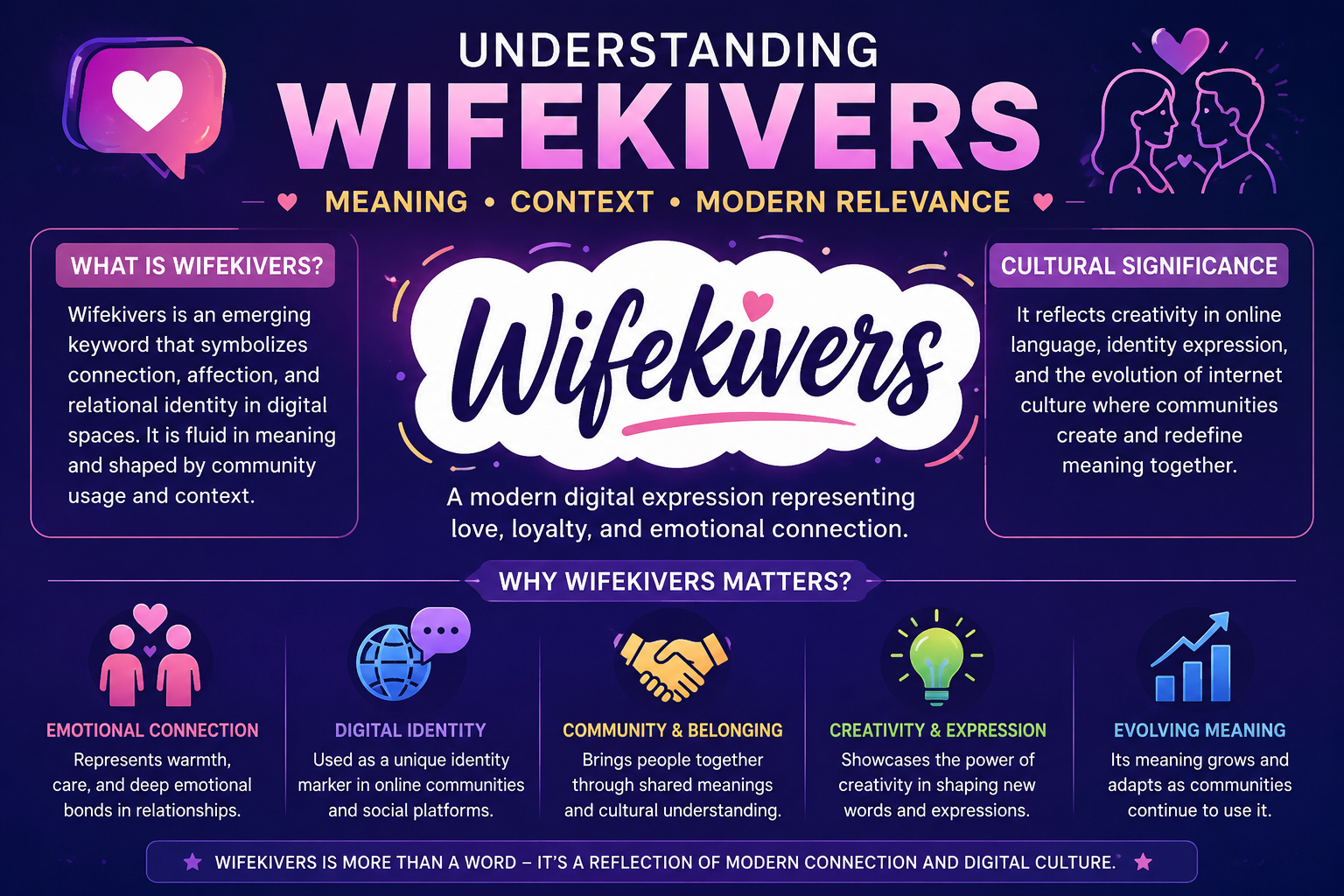
The term wifekivers is best understood as a conceptual or emerging keyword rather than a formally defined word with a single meaning. In digital spaces, such terms often develop organically, shaped by user interpretation rather than institutional definition. Wifekivers may be seen as a blend of ideas relating to relationships, identity, emotional roles, or symbolic representation within personal or online contexts.
In many cases, terms like emerge from community-driven language experimentation. Online users often combine familiar linguistic fragments to create new expressions that reflect humor, identity, emotional nuance, or social commentary. Because of this, can carry multiple layers of meaning depending on the context in which it is used.
For some, wifekivers might represent an affectionate or symbolic label connected to relational dynamics. For others, it may function as a playful or abstract identity marker used within online conversations. The flexibility of interpretation is what makes such terms particularly interesting in the study of digital linguistics.
Rather than having a rigid definition, wifekivers exists as a fluid concept shaped by usage patterns, emotional tone, and cultural environment. This fluidity is increasingly common in modern internet language, where meaning is often co-created by users rather than dictated by formal authority.
The Origins and Evolution of Wifekivers
Understanding the origins of wifekivers requires a broader look at how internet language evolves. Most modern digital terms are born within social media platforms, gaming communities, or niche online forums where creativity in language is both encouraged and rapidly spread.
Wifekivers likely follows this same pattern of organic emergence. It may have originated as a coined phrase or username that gradually gained attention due to its uniqueness and memorability. Over time, as more users encountered the term, it began to accumulate meaning through repeated use in different contexts.
The evolution of such terms is rarely linear. Instead, it resembles a branching process where each new usage slightly alters or expands the meaning. may have started with a specific intent or playful meaning, but as it spread across different online spaces, it could have taken on broader or even entirely different interpretations.
This kind of linguistic evolution is a defining feature of internet culture. Words no longer require formal approval or linguistic validation to become meaningful. Instead, collective usage determines their relevance. Wifekivers is an example of how digital communities actively participate in shaping language in real time.
Cultural Significance of Wifekivers in Digital Spaces
The cultural significance of wifekivers lies in its reflection of how online communities construct identity and meaning. In the digital age, language is not only a tool for communication but also a medium for self-expression and social belonging.
Wifekivers may function as a symbolic expression of relational identity, emotional connection, or community affiliation. In many online environments, users adopt unique terms to differentiate themselves, express personality traits, or signal membership within a particular group. fits into this broader pattern of symbolic digital language.
Another important cultural aspect is the role of creativity. Internet users frequently enjoy experimenting with language, blending sounds, meanings, and cultural references to create new expressions. Wifekivers represents this creative freedom, where meaning is not fixed but continuously reshaped by interaction.
Additionally, such terms often gain cultural value simply through repetition and recognition. Even without a formal definition, a keyword like can become meaningful if enough people engage with it in consistent ways. This demonstrates how digital culture prioritizes shared understanding over strict linguistic rules.
Psychological and Social Interpretations of Wifekivers
From a psychological perspective, the emergence of terms like wifekivers can be linked to human needs for identity formation, belonging, and emotional expression. Language plays a central role in how individuals define themselves and connect with others, especially in online environments where traditional social cues are limited.
Wifekivers may serve as a symbolic identity marker that allows individuals to express aspects of personality or relational perception in a simplified form. In digital communication, where brevity and creativity are often valued, such terms can carry significant emotional or social weight despite their simplicity.
Socially, reflects the collaborative nature of meaning-making in online communities. Unlike traditional language systems where meanings are fixed, digital spaces encourage continuous reinterpretation. This creates a dynamic environment where users collectively shape how a term is understood.
The psychological appeal of such terms also lies in their uniqueness. Using or engaging with a distinctive keyword like wifekivers can create a sense of individuality while still maintaining connection to a broader community. This balance between uniqueness and belonging is a key feature of online identity formation.
Wifekivers in Modern Communication and Online Interaction
In modern communication, especially within social media platforms, language evolves rapidly to keep pace with changing modes of interaction. Wifekivers represents how new expressions can emerge to fulfill communicative needs that traditional language may not fully capture.
Online conversations often rely on shorthand expressions, symbolic terms, and creative word formations to convey complex ideas quickly. In this context, can function as a flexible linguistic tool that adapts to different conversational settings.
Its usage may vary depending on the tone of the conversation, the relationship between users, and the cultural environment of the platform. In some cases, it may be used playfully, while in others it might carry more personal or symbolic meaning.
The adaptability of wifekivers highlights a broader trend in digital communication: the shift from fixed meaning to contextual meaning. Instead of relying on dictionary definitions, users interpret terms based on situational cues, shared understanding, and emotional context.
Misconceptions and Misinterpretations of Wifekivers
As with many emerging digital terms, can be subject to misunderstanding. One common misconception is the assumption that it has a single, universally accepted definition. In reality, its meaning is fluid and depends heavily on context and user interpretation.
Another misconception is that such terms must originate from formal linguistic systems or established cultural references. In truth, many internet-born words like develop spontaneously without formal origins, gaining meaning through usage rather than design.
There is also a tendency to overanalyze or assign overly rigid interpretations to flexible digital expressions. While analysis can be useful, it is important to recognize that part of the value of wifekivers lies in its openness and adaptability.
Understanding these misconceptions helps create a more accurate perspective on how modern digital language functions. It emphasizes that meaning in online environments is often collaborative, evolving, and situational rather than fixed.
Practical Insights into Understanding Wifekivers
To better understand wifekivers, it is helpful to approach it as a living expression rather than a static definition. Observing how it is used in different contexts provides more insight than attempting to assign a single meaning.
In practical terms, interpreting wifekivers involves paying attention to tone, surrounding language, and the nature of the conversation in which it appears. These contextual clues often reveal more about its intended meaning than the word itself.
Another useful approach is to recognize the role of digital communities in shaping such terms. Wifekivers exists within a shared linguistic environment where meaning is collectively constructed. This means that its interpretation may differ across platforms, groups, or even individual users.
Understanding this dynamic can improve digital literacy and communication skills, especially in environments where new terms frequently emerge. It encourages flexibility in interpretation and openness to evolving meanings.
The Future of Wifekivers in Digital Language
The future of wifekivers depends largely on how it continues to be used within online communities. Some digital terms fade quickly after their initial emergence, while others evolve into more established expressions with lasting cultural impact.
If wifekivers continues to be adopted and adapted, it may develop more defined meanings over time. Alternatively, it may remain a flexible and open-ended expression that shifts depending on context and usage trends.
The broader trend suggests that digital language will continue to evolve in this direction. As online communication becomes even more central to daily life, the creation of new terms like wifekivers will likely increase. These expressions reflect the creativity and adaptability of internet culture.
In this sense, wifekivers is not just a standalone keyword but part of a larger linguistic movement where meaning is continuously negotiated and reshaped by users around the world.
Conclusion
Wifekivers represents more than just an unusual or emerging keyword in digital spaces. It reflects the dynamic nature of modern language, where meaning is shaped by communities, context, and continuous interaction rather than fixed definitions.
Throughout this article, we explored how wifekivers can be understood as a flexible conceptual term influenced by digital culture, psychological expression, and social communication patterns. Its significance lies not in a single definition but in its adaptability and the way it reflects broader trends in online language evolution.
As digital communication continues to expand, terms like wifekivers will play an increasingly important role in shaping how people express identity, emotion, and connection. Understanding such expressions provides valuable insight into the future of language itself, where creativity and collective meaning-making define how we communicate in an ever-changing digital world.