Introduction to Beliktal
Beliktal is an emerging conceptual keyword that represents a modern way of understanding structured growth, adaptive thinking, and interconnected development across different areas of life and work. While the term itself may appear unfamiliar at first glance, its deeper interpretation revolves around the idea of building balance between systems, decisions, and outcomes in a way that promotes long-term clarity and efficiency. In today’s fast-changing world, concepts like Beliktal are becoming increasingly relevant because they help individuals and organizations navigate complexity without losing direction.
The significance of Beliktal lies in its flexible nature. It is not limited to one strict definition or field, but instead adapts to different contexts such as personal development, business strategy, technology systems, and even educational frameworks. This adaptability is what makes a powerful idea to explore. It encourages structured thinking while also allowing room for creativity and innovation. In essence, can be understood as a guiding principle for achieving harmony between planning and execution.
As modern environments become more dynamic and unpredictable, the need for concepts like Beliktal increases. People and organizations often struggle to maintain consistency while also adapting to change. Beliktal addresses this challenge by promoting a balanced approach where stability and flexibility coexist. This article explores in depth, breaking down its meaning, principles, applications, benefits, and future potential in a clear and detailed manner.
Understanding the Concept of Beliktal
To fully understand , it is important to view it as a conceptual framework rather than a fixed definition. At its core, Beliktal represents a structured approach to managing complexity through balanced alignment of goals, processes, and outcomes. It emphasizes clarity in decision-making while also supporting adaptability when conditions change.
Beliktal can be seen as a mindset that encourages individuals to think beyond linear solutions. Instead of focusing on isolated actions, it promotes interconnected thinking where every decision is understood in relation to a larger system. This systems-based perspective helps in identifying patterns, predicting challenges, and creating more sustainable solutions.
Another important aspect of is its emphasis on alignment. In many situations, problems arise not because of lack of effort, but because of misalignment between intention and execution. encourages continuous evaluation of whether actions are aligned with desired outcomes. This makes it a dynamic and ongoing process rather than a one-time solution.
In practical terms, Beliktal can be applied in decision-making, planning, and execution phases across various activities. It supports structured thinking while ensuring that flexibility is not lost. This balance is what makes it especially valuable in complex environments where uncertainty is common.
The Origin and Evolution of Beliktal
The idea of Beliktal can be understood as a modern conceptual development influenced by multiple disciplines such as systems thinking, strategic planning, and cognitive psychology. Although the term itself may not have a traditional historical origin, its conceptual roots are deeply connected to the evolution of structured thinking models that aim to simplify complexity.
Over time, human systems have evolved from rigid, hierarchical structures to more flexible and adaptive networks. In earlier models, decision-making was often linear and centralized, leaving little room for adaptation. However, as environments became more complex, the need for more dynamic frameworks became apparent. Beliktal emerges from this shift toward flexibility combined with structure.
The evolution of Beliktal reflects a growing awareness that success in modern environments depends on the ability to balance order and adaptability. Traditional models often focused too heavily on control, while modern approaches emphasize responsiveness. bridges these two extremes by offering a middle path where structure guides action, but flexibility allows evolution.
In recent years, the conceptual relevance of has expanded due to advancements in technology, communication, and global connectivity. These factors have increased the speed of change, making rigid systems less effective. As a result, has gained importance as a way of thinking that aligns with modern needs.
Core Principles of Beliktal
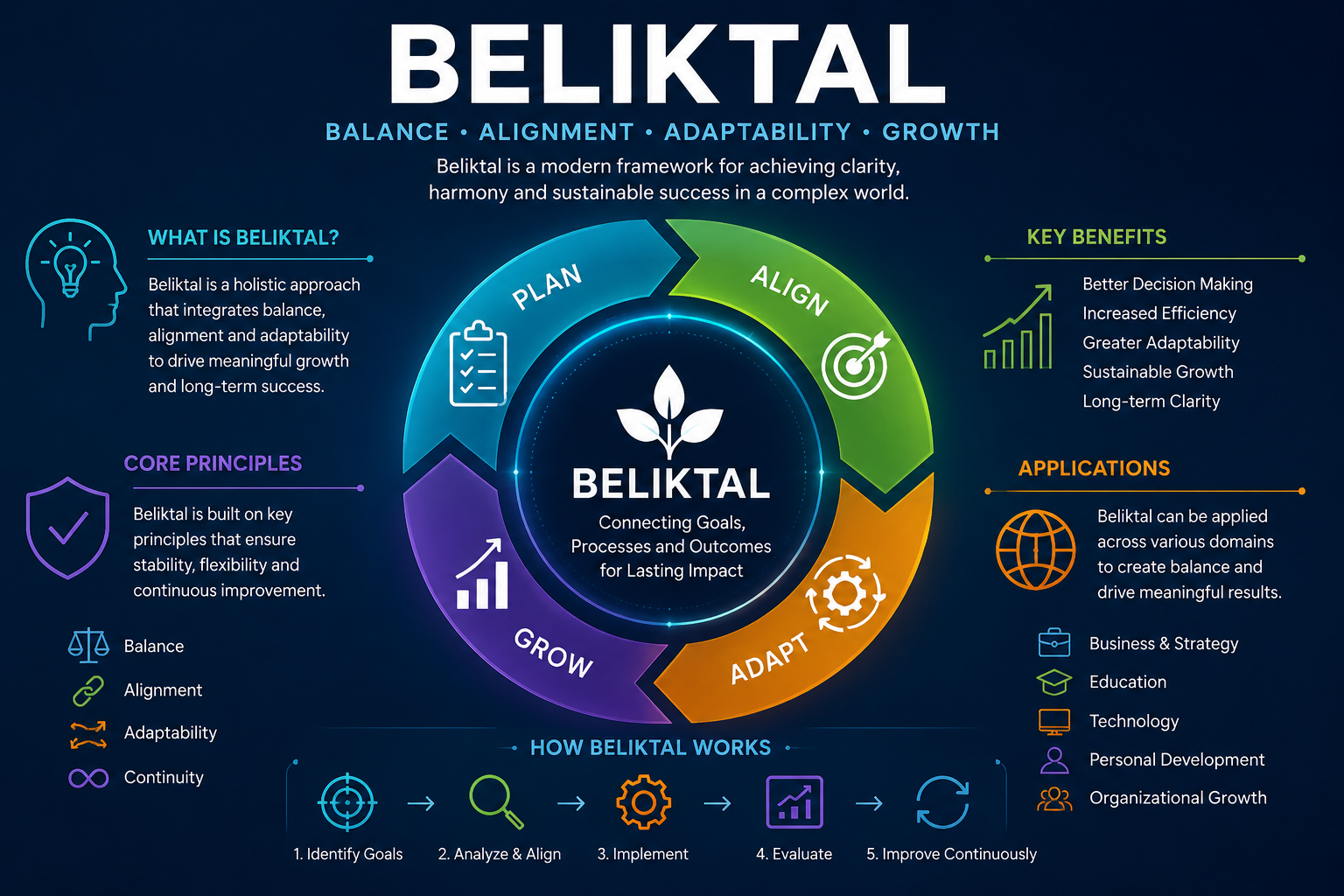
The foundation of Beliktal is built on several core principles that define how it operates as a conceptual framework. These principles are not strict rules but guiding ideas that help shape its application in different contexts.
One of the central principles of Beliktal is balance. This refers to the ability to maintain stability while remaining open to change. Balance ensures that systems do not become too rigid or too chaotic. It allows for steady progress while accommodating new information and adjustments.
Another important principle is alignment. Beliktal emphasizes the importance of ensuring that actions are consistently aligned with goals. Misalignment often leads to inefficiency, wasted effort, and confusion. Through continuous alignment, Beliktal promotes clarity and purpose in every stage of execution.
Adaptability is also a key principle within . In a rapidly changing environment, the ability to adjust without losing direction is essential. supports adaptive thinking by encouraging regular reassessment of strategies and outcomes.
Interconnectedness plays a significant role as well. views systems as interconnected rather than isolated. This means that changes in one area can influence multiple other areas. Understanding these connections helps in making more informed and effective decisions.
Lastly, continuity is an important principle. Beliktal is not a one-time process but an ongoing cycle of evaluation, adjustment, and improvement. This continuous nature ensures long-term relevance and sustainability.
Importance of Beliktal in the Modern World
In today’s world, complexity is a defining characteristic of almost every field. Whether it is business, education, technology, or personal life, individuals and organizations face constant change and uncertainty. Beliktal is important because it provides a way to navigate this complexity with clarity and structure.
One of the key reasons is important is its ability to improve decision-making. By encouraging alignment and systems thinking, it helps individuals evaluate situations more comprehensively. This leads to better choices that are informed by a broader understanding of consequences.
Beliktal is also important because it enhances adaptability. In environments where conditions change rapidly, the ability to adjust strategies is crucial. Beliktal ensures that adaptation does not come at the cost of losing direction or purpose.
Another significant aspect of its importance is efficiency. When systems are aligned and interconnected, resources are used more effectively. This reduces waste and improves overall performance.
In addition, supports long-term thinking. Instead of focusing solely on immediate outcomes, it encourages consideration of future implications. This forward-thinking approach is essential for sustainable growth and development in any field.
Applications of Beliktal in Different Domains
Beliktal can be applied across a wide range of domains due to its flexible and adaptive nature. In business environments, it can help organizations improve strategic planning, optimize operations, and enhance decision-making processes. By applying Beliktal, businesses can better align their goals with market conditions and internal capabilities.
In education, Beliktal can support more effective learning systems. It encourages the integration of different knowledge areas and promotes a more holistic understanding of subjects. This helps students develop critical thinking skills and the ability to connect ideas across disciplines.
In technology, Beliktal can be used to design more efficient systems and processes. It supports the creation of interconnected digital environments where different components work together seamlessly. This is especially important in fields such as software development, artificial intelligence, and data management.
On a personal level, can be applied to improve self-management and decision-making. It encourages individuals to reflect on their goals, align their actions with their values, and remain adaptable in the face of change. This leads to greater clarity and personal growth.
In organizational development, helps create more cohesive and adaptive structures. It ensures that teams work in alignment with overall objectives while maintaining flexibility to respond to new challenges.
How Beliktal Works as a Framework
Beliktal operates as a dynamic framework that combines structure with adaptability. It begins with the identification of goals and desired outcomes. These goals serve as the foundation for all subsequent actions and decisions.
Once goals are established, the next step involves analyzing the current system and identifying areas of alignment and misalignment. This process helps in understanding how different components interact and where adjustments are needed.
After analysis, strategies are developed to improve alignment and enhance system efficiency. These strategies are not fixed but are designed to evolve over time as new information becomes available.
Implementation is followed by continuous evaluation. This ensures that the system remains aligned with its goals and can adapt to changing conditions. Feedback plays a crucial role in this stage, as it provides insights into what is working and what needs improvement.
The cyclical nature of ensures that it remains relevant and effective over time. It is not a static model but a living framework that evolves with its environment.
Benefits of Adopting Beliktal
Adopting Beliktal offers several important benefits across different areas of application. One of the most significant benefits is improved clarity. By focusing on alignment and structure, helps reduce confusion and enhances understanding of complex situations.
Another major benefit is increased efficiency. When systems are well-aligned, resources are used more effectively, leading to better outcomes with less waste. This efficiency is valuable in both personal and organizational contexts.
Beliktal also enhances adaptability. In a rapidly changing world, the ability to adjust without losing direction is essential. provides a framework that supports this balance.
Better decision-making is another key benefit. By encouraging systems thinking, helps individuals and organizations make more informed and strategic choices.
Additionally, Beliktal supports long-term sustainability. Instead of focusing only on short-term gains, it encourages planning that considers future impacts and outcomes.
Challenges and Limitations of Beliktal
Despite its advantages, Beliktal also comes with certain challenges and limitations. One of the primary challenges is its abstract nature. Because it is a conceptual framework, it may be difficult for some individuals to fully understand or apply without proper interpretation.
Another challenge is the need for consistent evaluation. Beliktal requires ongoing attention and adjustment, which can be time-consuming and demanding. Without commitment, it may lose effectiveness.
There is also the risk of over-complexity. Since Beliktal focuses on interconnected systems, there is a possibility of becoming overwhelmed by too many variables. This can make decision-making more complicated if not managed carefully.
Additionally, implementing Beliktal effectively requires a certain level of analytical thinking and awareness. Without these skills, it may be difficult to fully benefit from the framework.
Strategies for Implementing Beliktal Effectively
Successful implementation of Beliktal requires a thoughtful and structured approach. It begins with developing a clear understanding of goals and desired outcomes. This clarity forms the foundation for all further actions.
The next step involves analyzing current systems and identifying areas that require improvement. This helps in creating a realistic picture of the existing situation.
Once this understanding is established, gradual adjustments can be made to improve alignment. These adjustments should be monitored carefully to ensure they are producing the desired results.
Continuous reflection and evaluation are essential for maintaining effectiveness. This ensures that the system remains aligned and adaptable over time.
It is also important to maintain simplicity where possible. While deals with complex systems, keeping processes clear and manageable helps prevent unnecessary complications.
The Future of Beliktal
The future of Beliktal is closely tied to the increasing complexity of modern systems. As technology continues to evolve and global interactions become more interconnected, the need for adaptive frameworks like Beliktal is expected to grow.
Beliktal may play a significant role in shaping future approaches to strategy, education, and organizational development. Its emphasis on balance and alignment makes it particularly suitable for environments that require both structure and flexibility.
As more people and organizations recognize the value of systems thinking, is likely to become more widely adopted and refined. It may also evolve further as new insights and applications emerge over time.
The continued relevance of Beliktal will depend on its ability to remain adaptable and applicable across different contexts. Given its flexible nature, it has strong potential to remain a valuable conceptual tool in the future.
Conclusion
Beliktal represents a powerful conceptual framework that emphasizes balance, alignment, adaptability, and interconnected thinking. It offers a structured yet flexible approach to understanding and managing complexity in modern environments.
Through its principles and applications, Beliktal provides valuable insights into how individuals and organizations can improve decision-making, efficiency, and long-term sustainability. While it comes with certain challenges, its benefits make it a highly relevant concept in today’s rapidly changing world.
As systems continue to grow more complex, the importance of frameworks like Beliktal will only increase. It encourages a way of thinking that is both structured and adaptable, making it a useful guide for navigating uncertainty and achieving meaningful progress.