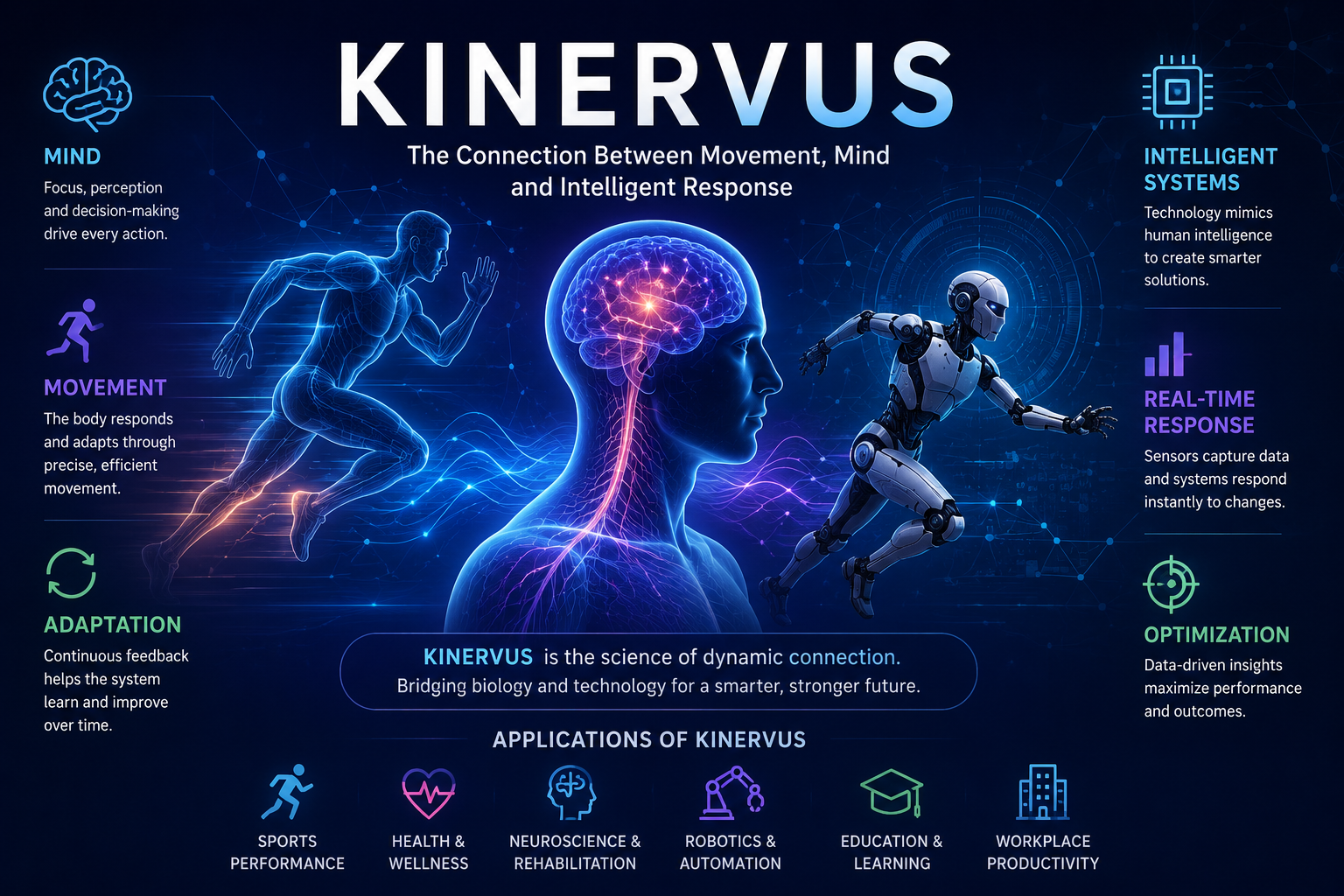
Introduction to Kinervus
Kinervus is an emerging conceptual framework that blends ideas of human performance, adaptive systems, and intelligent responsiveness into a unified model. While the term itself may appear unfamiliar at first, Kinervus represents a growing way of thinking about how movement, cognition, and technology can interact in dynamic environments. In simple terms, Kinervus can be understood as a system or philosophy that explores the connection between kinetic energy, nervous system responsiveness, and adaptive intelligence in both biological and artificial contexts.
In today’s rapidly evolving world, where technology is deeply integrated into human life, concepts like Kinervus are becoming increasingly relevant. People are constantly seeking ways to improve efficiency, mental clarity, physical performance, and system responsiveness. Kinervus provides a lens through which these goals can be understood not as separate pursuits but as interconnected elements of a larger adaptive ecosystem.
At its core, focuses on the idea that every action, whether physical or cognitive, is part of a continuous feedback loop. This loop is influenced by internal states such as emotion, focus, and physical condition, as well as external conditions like environment, data input, and technological interaction. By understanding Kinervus, individuals and systems can potentially achieve higher levels of harmony, efficiency, and responsiveness.
This article explores in depth, breaking down its meaning, foundational principles, real-world applications, benefits, challenges, and future potential. The goal is to provide a clear, detailed, and practical understanding of Kinervus so that readers can grasp not only what it represents but also how it can be applied in meaningful ways.
Understanding the Meaning and Concept of Kinervus
To understand Kinervus properly, it is important to break the term into its conceptual roots. Although it is not a standard dictionary word, can be interpreted as a fusion of “kinetic” and “nervous,” suggesting a relationship between movement and the nervous system. This interpretation positions as a concept that studies how motion and neurological response interact in both natural and engineered systems.
In biological terms, Kinervus reflects the way the human nervous system controls movement, reaction, and adaptation. Every physical action a person performs is guided by electrical signals transmitted through neural pathways. These signals allow the body to respond to stimuli, maintain balance, and adapt to changing conditions. In this sense, Kinervus represents the invisible coordination between thought and motion that defines human behavior.
In a broader technological context, can also represent systems that mimic or enhance this biological coordination. Artificial intelligence, robotics, wearable technology, and smart environments all rely on feedback loops similar to those found in the human nervous system. These systems sense inputs, process information, and produce outputs that influence future behavior. Kinervus, therefore, becomes a conceptual bridge between human biology and machine intelligence.
Another important aspect of is its focus on adaptation. Unlike static systems that operate in fixed patterns, Kinervus-based systems are dynamic. They continuously adjust based on feedback, learning from previous interactions to improve future responses. This adaptive nature makes Kinervus particularly relevant in fields where flexibility and responsiveness are essential.
Ultimately, Kinervus is not just a technical idea but also a philosophical one. It encourages a shift in thinking from linear processes to interconnected systems. Instead of viewing actions as isolated events, suggests that everything is part of an ongoing cycle of input, processing, and response.
The Core Principles Behind Kinervus
The foundation of is built on several interconnected principles that define how it operates across different contexts. These principles help explain why Kinervus is such a powerful conceptual model for understanding both human and artificial systems.
One of the central principles of is responsiveness. Responsiveness refers to the ability of a system, whether biological or technological, to react quickly and appropriately to changes in its environment. In the human body, this is seen in reflex actions, sensory perception, and cognitive decision-making. In technological systems, responsiveness is achieved through sensors, algorithms, and real-time data processing.
Another key principle is adaptation. Kinervus emphasizes that systems should not only respond to immediate stimuli but also evolve based on repeated experiences. This means learning from patterns, identifying trends, and adjusting behavior over time. Adaptation ensures long-term efficiency and relevance in changing environments.
Integration is also a fundamental aspect of . In this context, integration refers to the seamless connection between different components of a system. In the human body, this involves the coordination between the brain, spinal cord, and peripheral nerves. In artificial systems, it involves the integration of hardware, software, and data streams. Kinervus highlights the importance of unified functioning rather than isolated operations.
Another principle is balance. Kinervus recognizes that effective systems must maintain equilibrium between input and output, stimulation and response, or energy consumption and efficiency. Without balance, systems can become unstable, inefficient, or unsustainable. This principle is particularly important in both physical performance and technological design.
Finally, Kinervus is guided by the principle of continuous feedback. Feedback loops are essential for maintaining system stability and promoting improvement. Every action generates a reaction, and that reaction becomes new information for future actions. This ongoing cycle is at the heart of and is what allows systems to evolve intelligently over time.
Applications of Kinervus in the Modern World
Kinervus has wide-ranging applications across multiple domains, especially in fields where interaction between humans and systems is essential. One of the most significant areas where is applied is human performance optimization. Athletes, professionals, and individuals seeking self-improvement can benefit from understanding how their nervous system interacts with physical movement and cognitive decision-making. By aligning these elements more effectively, performance can be enhanced in both physical and mental tasks.
In the field of technology, plays an important role in the development of intelligent systems. Artificial intelligence platforms, machine learning models, and robotics systems all rely on principles similar to those found in Kinervus. These systems must process inputs, learn from data, and adjust their outputs accordingly. The more effectively they mimic Kinervus-like behavior, the more efficient and intelligent they become.
Healthcare is another area where has significant implications. Rehabilitation programs, neurotherapy, and assistive technologies all depend on understanding the relationship between neural signals and physical movement. Kinervus-based approaches can help design better rehabilitation systems that respond dynamically to patient progress, improving recovery outcomes.
In workplace environments, Kinervus can be applied to improve productivity and decision-making. Modern workplaces are increasingly dependent on digital tools and real-time communication systems. By applying Kinervus principles, organizations can create workflows that are more responsive, adaptive, and efficient. This leads to better collaboration and faster problem-solving.
Education is also influenced by Kinervus-based thinking. Adaptive learning systems that adjust content based on student performance are an example of in action. These systems respond to learner behavior and modify instructional approaches to improve understanding and retention. This creates a more personalized and effective educational experience.
Even in everyday life, can be observed in the way individuals interact with technology. Smartphones, wearable devices, and smart home systems all rely on feedback loops that mirror Kinervus principles. These devices learn from user behavior and adjust their functionality to better suit individual needs.
Benefits and Challenges of Kinervus
The adoption and understanding of Kinervus bring a wide range of benefits. One of the most important benefits is improved efficiency. By emphasizing feedback, adaptation, and integration, allows both biological and technological systems to operate more smoothly and with fewer wasted resources. This leads to better performance and more effective outcomes.
Another benefit is enhanced adaptability. In a world that is constantly changing, the ability to adapt quickly is essential. -based systems are designed to respond to change in real time, making them highly resilient in unpredictable environments. This adaptability is valuable in fields such as business, healthcare, and technology.
Kinervus also supports improved decision-making. By continuously processing feedback and adjusting responses, systems and individuals can make more informed decisions. This reduces errors and increases the likelihood of successful outcomes. Over time, this leads to a more refined and intelligent approach to problem-solving.
Despite these benefits, Kinervus also presents certain challenges. One of the main challenges is complexity. Because Kinervus involves multiple interconnected systems and feedback loops, it can be difficult to design, implement, and manage effectively. This complexity requires specialized knowledge and careful planning.
Another challenge is the need for accurate data. Since relies heavily on feedback, the quality of input data plays a crucial role in system performance. Inaccurate or incomplete data can lead to poor decisions and inefficient outcomes. Ensuring data accuracy and reliability is therefore essential.
There is also the challenge of balancing automation and human control. As -based systems become more advanced, there is a risk of over-reliance on automation. Maintaining a balance between human judgment and system intelligence is important to ensure ethical and practical use.
Finally, implementation costs can be a barrier. Developing systems that fully incorporate Kinervus principles may require significant investment in technology, research, and training. This can limit accessibility for smaller organizations or individuals.
The Future of Kinervus and Its Evolving Role
The future of Kinervus is closely tied to advancements in technology, neuroscience, and artificial intelligence. As these fields continue to evolve, the principles of are likely to become even more relevant and widely applied. One of the most promising areas of development is the integration of human cognition with machine intelligence. Brain-computer interfaces and neuroadaptive systems are already beginning to explore this space, and Kinervus provides a useful conceptual framework for understanding these innovations.
In the coming years, Kinervus may play a central role in the development of fully adaptive environments. These environments would be capable of responding to human behavior in real time, adjusting lighting, temperature, information flow, and system responses based on user needs. This would create highly personalized and efficient living and working spaces.
Another important future direction is the use of Kinervus in advanced robotics. Robots that can learn, adapt, and respond in real time will rely heavily on feedback-based systems similar to those described by Kinervus. This could lead to more natural human-robot interaction and greater autonomy in robotic systems.
In healthcare, Kinervus may contribute to the development of highly personalized treatment plans. By continuously monitoring patient data and adjusting treatment strategies in real time, healthcare systems could become more responsive and effective. This could significantly improve patient outcomes and reduce recovery times.
Education systems may also become increasingly Kinervus-driven, with fully adaptive learning environments that respond not only to academic performance but also to emotional and cognitive states. This would allow for a more holistic approach to learning that supports individual growth.
As Kinervus continues to evolve, it is likely to become a foundational concept in the study of complex systems. Its emphasis on integration, feedback, and adaptation makes it applicable to nearly every field that involves dynamic interaction. Whether in technology, biology, or social systems, offers a powerful framework for understanding and improving the way systems function.
Conclusion
Kinervus represents a forward-thinking concept that bridges the gap between movement, cognition, and adaptive intelligence. By focusing on the interconnected nature of systems, it provides a deeper understanding of how actions and responses shape both biological and technological processes. From human performance and healthcare to artificial intelligence and education, offers valuable insights that can transform the way systems are designed and understood.
Its emphasis on responsiveness, adaptation, integration, balance, and feedback makes it a versatile framework for addressing modern challenges. While there are complexities and challenges associated with its implementation, the potential benefits far outweigh the limitations.
As technology continues to evolve and merge more closely with human behavior, is likely to play an increasingly important role in shaping the future. It encourages a more holistic view of systems, one that recognizes the continuous interaction between input and output, thought and action, human and machine.
In this way, Kinervus is not just a concept but a way of understanding the world as an interconnected, evolving system where every action contributes to a larger cycle of adaptation and growth.